


They Built A Brand Bringing World Class Music Experiences To Underserved Markets
Adam Lynn and Zach Ruben did not build Breakaway by chasing the same cities, the same audiences or the same festival blueprint as everyone else. They went where major touring acts rarely bothered to stop, turned college towns into electronic music destinations and built one of North America’s most ambitious independent live platforms. Now operating across festivals, concerts, management and recorded music, the founders are working out how far Breakaway can grow without losing the instinct that made it matter in the first place.
The American festival map has always been brutally repetitive.
The biggest artists move between the biggest cities. Promoters compete for the same audiences, the same sponsorship budgets and the same available weekends. New events are often launched in markets already overflowing with entertainment, each one promising a different experience while fighting over an almost identical crowd.
Adam Lynn and Zach Ruben saw more value in the blank spaces.
Before Breakaway became a national touring festival, the pair were already developing a strategy around cities that the wider concert business routinely ignored. Their attention was focused on college towns and smaller markets where demand existed, but major touring infrastructure had failed to catch up.
“When you go back to the origin story before Breakaway even started, when it was Prime Social Group, Zach’s and my entire thesis was about bringing concerts to small markets and underserved cities,” Lynn says. “Primarily college towns, because huge touring artists weren’t playing these markets.”
It was not complicated. Young audiences in Columbus, Charlotte or college markets across the Midwest wanted access to the same artists, production and live experiences available in New York, Miami, Los Angeles or Chicago. The industry had largely decided those audiences could travel if they cared enough.
Breakaway brought the experience to them.
“When the concept of Breakaway came around, we wanted to keep that thesis the same,” Lynn says. “Although the markets grew in size, we remained focused on underserved markets. We’d rather bring this huge experience to markets that aren’t getting those kinds of experiences.”
The strategy first took shape in Ohio, then expanded into Michigan, North Carolina and Nashville. Breakaway now operates across 13 cities, with further growth clearly available. The markets may have become larger, but the logic remains intact.
“It started in college markets, and here we are all these years later, in slightly bigger cities, with the same thesis,” Lynn says.
That thesis has become Breakaway’s identity. The festival does not drop into a city as a detached national brand, collect ticket revenue and disappear. Its entire reputation depends on understanding places that larger promoters still treat as secondary.
The company built its scale from the outside in.
BEFORE THE INDUSTRY CATCHES UP
Lynn and Ruben have spent much of their careers identifying artists before their fees, audiences and industry expectations explode. That ability is often described as instinct, although instinct usually comes from years of watching how artists behave when the spotlight is still small.
Talent alone is not the deciding factor.
Ruben points towards artists willing to leave the obvious touring routes, play developing markets and build their audience in person rather than relying entirely on digital momentum.
“Artists that really invest in touring and getting out to play markets, especially underserved markets, seem to have longer sustainability and generally a better career,” he says. “Obviously, it has to be backed up with music, releases and building their fan community. You see that residual payback down the road.”
The artists who last are rarely the ones who treat early touring as something beneath them. They play rooms where the infrastructure is imperfect, the travel is inconvenient and the market does not yet come with obvious prestige. Those shows create the kind of loyalty that cannot be assembled through paid content or playlisting.
Breakaway’s history is full of artists caught before the rest of the business fully understood what was coming.
“Avicii stands out as one of our early success stories,” Ruben says. “I remember booking The Chainsmokers for $1,500 for a party in Columbus. Steve Aoki was on our first tour. One of the first times Adam and I worked together was on a Steve Aoki Goes to College bus tour in 2010.”
Those stories now sound almost absurd. The Chainsmokers for $1,500. Avicii before the scale of his influence became obvious. Aoki moving through college markets before electronic music’s first major American commercial wave reached its peak.
At the time, none of it came with certainty.
Spotting an artist early is not the same as discovering a finished product. It means seeing the potential inside a project before the production, audience and cultural timing fully align. It means accepting that some bets will fail and understanding that the artists who eventually break rarely do so according to a clean industry schedule.
Breakaway grew alongside several of them.
FROM MULTI-GENRE FESTIVAL TO FULL ELECTRONIC COMMITMENT
Breakaway was not originally an electronic-only festival.
Its early lineups reflected the broad appetite of American youth culture at the time. Hip hop, indie, pop and electronic music shared the same bill. Kendrick Lamar, Travis Scott, Future, Migos, Halsey, Twenty One Pilots and Empire of the Sun all appeared during the brand’s multi-genre years.
“Breakaway started as a multi-genre festival,” Lynn says. “In our first couple of lineups, we had Kendrick Lamar, Empire of the Sun, Twenty One Pilots, Travis Scott, Future, Migos and Halsey.”
Then COVID stopped the live industry completely.
For festivals, the pandemic was catastrophic. Tours disappeared, staff were cut, venues went dark and almost every assumption supporting the live business became unstable. But the shutdown also forced promoters to question what their brands were actually supposed to be when the market returned.
Lynn and Ruben used the interruption to reset Breakaway.
“When COVID hit, it was an opportunity to reset many things,” Lynn says. “The entire live entertainment industry reset, giving us a chance to reset Breakaway as a brand.”
Electronic music had moved rapidly during isolation. Producers emerged through livestreams, online communities and a captive global audience spending more time behind screens. New names gained momentum without the normal touring circuit, while younger listeners moved deeper into dance music.
John Summit was one of the clearest examples.
“COVID was an important period for dance music,” Lynn says. “A lot of people were stuck on their computers, and a lot of great new talent emerged, with John Summit being one of the obvious ones.”
By 2021, the signals were impossible to ignore. Breakaway’s college ambassadors, influencers and younger audience were increasingly drawn towards electronic music. Lynn and Ruben decided to stop hedging.
“Zach and I decided to fully lean into dance music,” Lynn says. “We were seeing the trends, and we’ve always had a good sense of what’s happening with younger audiences.”
After the pandemic, Breakaway became a fully electronic festival.
It was a bet, but not a blind one.
“More and more of our college ambassadors and influencers were gravitating toward dance music,” Lynn says. “After COVID, Breakaway switched to a fully electronic format, and I think we bet right.”
Dance music is no longer contained within a specialist subculture in the US. Its production language now runs through pop, hip hop, fitness, gaming, advertising and social media. The audience has widened beyond club obsessives and festival veterans.
“You’re seeing EDM and dance music increasing, not only becoming a subgenre, but also a pop music trend,” Lynn says. “It’s becoming music that kids and their parents can listen to together. It’s not just the genre’s underground style anymore. It’s really becoming what people are generally listening to.”
That mainstream expansion has changed Breakaway’s economics. Audience sizes have grown in places that were once considered limited festival markets. Brands have become more comfortable investing in electronic music. The genre’s cultural reach now supports the kind of national platform Lynn and Ruben had been building for years.
“The audience size has increased significantly, even in smaller cities like Columbus, Minneapolis and Tampa,” Lynn says. “We’re also seeing brands resonate more. It’s been very exciting for us.”
Lynn and Ruben have now witnessed two distinct American dance music explosions.
The first arrived in the early 2010s, when EDM entered the centre of American pop culture and artists such as Calvin Harris, Tiësto, Avicii, NERVO and Steve Aoki reached enormous new audiences.
“Dance music had a huge moment in the early 2010s in the US, when we first booked Calvin Harris, Avicii, Tiësto, NERVO, Aoki and all these artists,” Lynn says.
The second is happening now.
“Here we are in 2026, and dance is kind of reigning king right now,” he says. “Coachella recently came out with some crazy stats. Very close to half of all the artists booked in 2026 were electronic artists. If you looked at that 10 years ago, it was probably a fraction of that.”
Breakaway is positioned directly inside that expansion, but without abandoning the cities where its original audience was built.
THE STANDARD GOT HIGHER
The problem with giving audiences access to more festivals is that they quickly learn what a good festival looks like.
When Breakaway first arrived in markets such as Columbus, Charlotte and Michigan, the existence of the event itself carried novelty. Many attendees were walking into their first large-scale festival. Expectations were different because there were fewer local comparisons.
That has changed.
“When we first started Breakaway, the idea of a festival coming to Columbus, Ohio, Charlotte or Michigan was new,” Lynn says. “As time has passed, festivals have become more mainstream, meaning festival-goers are attending more festivals than just Breakaways.”
Breakaway is no longer judged only against other regional events. Its audience travels. They attend destination festivals, watch stage designs from around the world and consume endless footage of major productions through social platforms.
A national brand operating in an underserved market is still expected to deliver at the highest level.
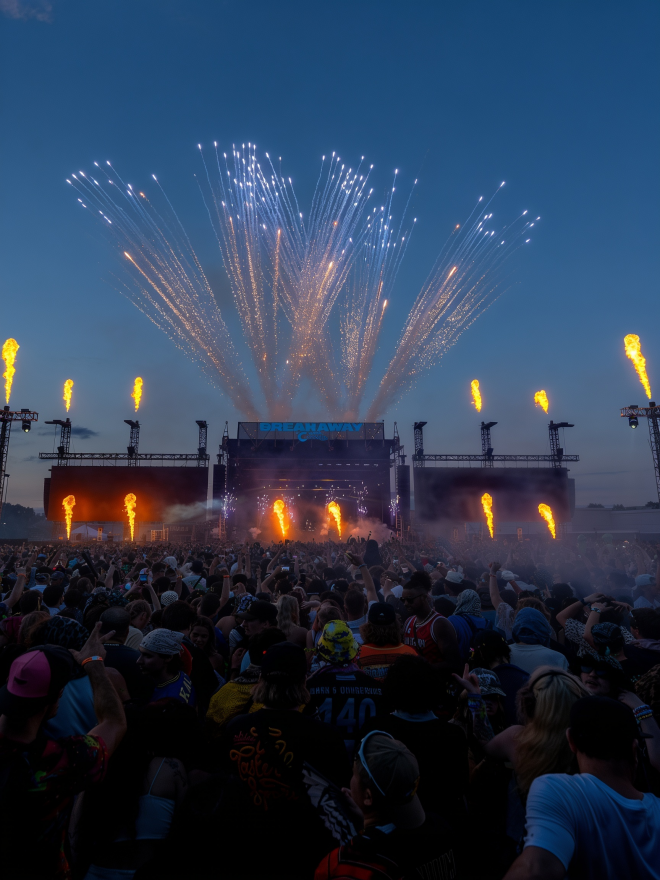
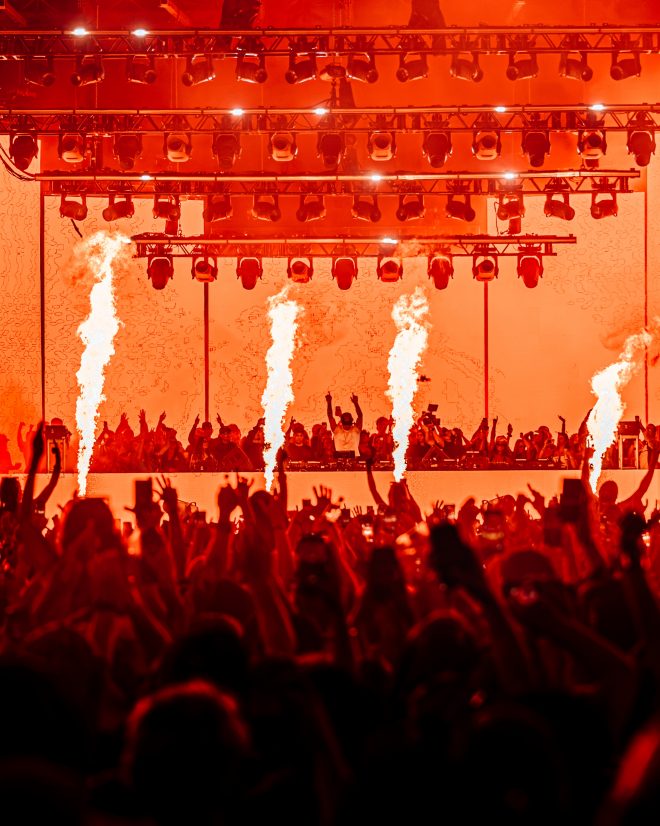
“What started as something designed around small markets has now become a much higher standard we have to maintain as an event,” Lynn says. “If you look at just the stage and the production year over year, the flash from 2018 to 2026, you can barely recognise that festival.”
The production expansion is not driven only by fans. Artists now arrive with their own technical standards, visual systems and expectations around stage scale. A festival competing for serious talent has to meet those demands.
“We’ve really had to grow and adapt with the market,” Lynn says. “It’s not only fans’ expectations. It’s the expectations of talent and the level of production they want.”
Breakaway’s challenge is delivering that production without turning its ticket prices into another luxury purchase.
“Although we’re still in these small markets and we’re really cognisant and keep our ticket price super low, we’re still spending quite a bit to bring this A-plus experience that people will see at some of their biggest festivals across the country,” Lynn says.
That financial balance becomes harder every year. Artist fees increase. Production costs rise. Insurance, labour, travel and infrastructure continue moving upwards. Breakaway’s answer has been to grow attendance without abandoning affordability.
“We’re happy and excited that we’ve still been able to make the financial model work with affordable tickets and smaller markets, despite this massive production,” Lynn says. “That has to do with the growing fan base and audience. We’re seeing much higher attendance than we ever have.”
Scale, however, creates another danger. A festival can become bigger while feeling less human.
NATIONAL TOUR, LOCAL FINGERPRINTS
Breakaway operates as a national brand, but Ruben is resistant to the idea that each event should feel like the same touring structure dropped into a different postcode.
The company’s relationship with local teams is central to preventing that.
“I think it really has to do with our connectivity to the local market and the event itself, and how hands-on our entire team is, from the executive leadership team down to every new hire,” Ruben says.
That internal involvement gives each person some ownership over the final experience.
“Everyone gets to have a little bit of a fingerprint on the event’s imprint,” he says.
Local promoters, venues and operational partners are not treated simply as contractors executing a national instruction manual. Their understanding of the city shapes how the event is built, marketed and experienced.
“We’ve done a really good job of building relationships with local partners, promoters and venues across all of our markets by embracing and ingraining ourselves in those local communities,” Ruben says.
The result is a format that can scale without becoming completely generic.
“While we are a national tour, a national brand, each event feels personal, and the experience is intimate.”
That intimacy is relative. Breakaway is not a basement party or a small club event. It involves large stages, heavy production, major artists and crowds numbering in the thousands. The connection comes from making the festival feel relevant to its location rather than like a corporate event briefly occupying it.
Local identity does not need to disappear when a company grows. It disappears when growth becomes more important than attention.
BUILDING THE WHOLE ECOSYSTEM
Breakaway now extends far beyond the festival gates.
The company operates concerts, artist management, recorded music, content and media, creating a wider system around the artists and audiences moving through its events.
For Lynn, the logic is based on the community Breakaway already controls.
“Because of the brand and community we’ve built, we create so much more value and service for both our fans and the talent we work with,” he says.
A festival relationship is temporary by nature. An artist plays for an hour. A fan attends for a weekend. A sponsor activates during the event. Then everyone moves on.
Additional verticals allow those relationships to continue.
“By entering new verticals and creating more opportunities, whether that’s opportunities for the talent, opportunities for our fans to connect with talent or discover talent, fans are able to engage with our brand through media, content and more,” Lynn says. “Brands are able to partner with us through other non-traditional ways outside of just the events themselves.”
The model turns Breakaway from an event company into a year-round platform.
For artists, it can mean moving from a festival booking into a label release, management relationship, content campaign or future touring opportunity. For fans, it creates additional discovery points outside the lineup announcement. For brands, it means access to a community that exists beyond one physical weekend.
The opportunity is obvious. So is the risk.
Every new business line creates more complexity, more capital requirements and more chances to lose focus. Breakaway’s founders are now dealing with a problem that would have seemed distant during the company’s early years: too many viable opportunities.
LEARNING TO SAY NO
Scaling a live business requires difficult personnel decisions, constant fundraising and an almost permanent tolerance for risk. Ruben, however, says the most demanding decisions often concern prioritisation.
“The hardest decisions, outside of the day-to-day hiring, firing and fundraising woes, have to be prioritising or choosing which opportunities we pursue,” he says.
Breakaway has already passed the scale its founders originally imagined.
“When Zach and I set out a decade ago with a plan for what we wanted a scaled Breakaway to be, we’ve now far surpassed what we ever thought it would be,” Lynn says. “Now we are in the green. We passed the goal point.”
Reaching that point has forced them to redraw the plan.
Growth can no longer mean accepting every available city, concept or partnership. The company has to defend what it has already built.
“We have to think about how we can maintain the brand, not overextend ourselves and continue to grow responsibly,” Lynn says.
Their different personalities help manage that tension.
“This is yin and yang,” Lynn says. “Zach is very responsible, and I like to shoot for the moon. It’s why we’ve been good business partners for so long.”
There is no shortage of possible directions. Breakaway could launch events in new genres, enter international markets, expand management, deepen its label operation or move into further live formats.
“There are opportunities: new genre festivals, international opportunities, new markets, label management and many new things,” Lynn says. “We want to continue growing and scaling in a thoughtful, smart manner.”
For Lynn, the real leadership challenge is restraint.
“That’s been, at least, the biggest challenge for me: being able to say no.”
The founders also occupy distinct positions inside the company.
“Leadership for Zach and I looks a little different,” Lynn says. “Zach’s always been the internal quarterback, and I’ve been the external voice and vision.”
Lynn’s role involves explaining the evolving plan to the market, partners and wider industry. Ruben’s focus is creating enough internal strength that leadership does not remain trapped at founder level.
“What I’ve learned about leadership is giving people the ability to lead and serve their role, empowering other leaders and continuing to strengthen that sense of core foundation that got us to where we are,” Ruben says.
A founder who cannot release control eventually becomes the limit of the company. Breakaway’s next phase will depend on whether its leadership culture can scale as effectively as its stages.
THE GATEWAY FESTIVAL
Youth culture now consumes entertainment across an endless mix of physical and digital formats. Festivals compete not only with other festivals, but with immersive exhibitions, creator-led events, pop-ups, sports entertainment and whatever new format captures attention next.
“Experiential entertainment is probably at its all-time peak, and there’s probably more of it than there ever has been,” Ruben says.
That abundance raises expectations but also reinforces the value of physical connection. Audiences spend more of their lives online while seeking increasingly intense reasons to leave it.
Breakaway’s role is often to provide the first major step into festival culture.
“We’ve always viewed Breakaway as the ‘gateway festival,’” Lynn says. “Although many of our consumers go on to see other festivals after us, we’re often the first festival they’ve experienced.”
That first arrival matters.
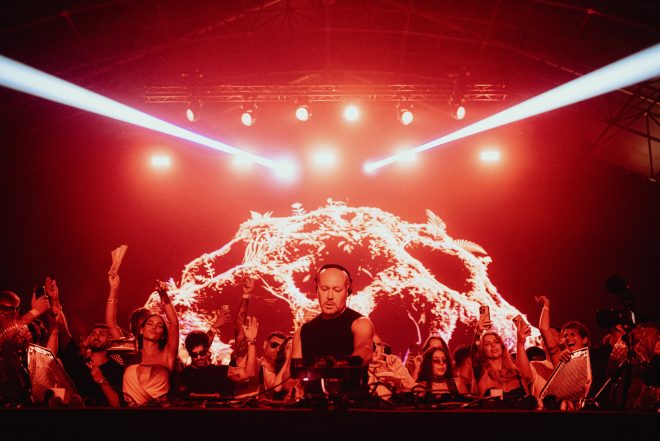
A new attendee walks into a space containing a massive main stage, a second stage, a silent disco, vendor villages, large-scale production and brand activations. For experienced festival audiences, those components may seem familiar. For someone entering that world for the first time, the scale can be overwhelming.
“They’re really wowed because it’s the first time they’ve experienced something like that,” Lynn says.
The company wants that first reaction to turn into a recurring relationship.
“We hope they love it so much that they come back, attend another Breakaway that year and return when Breakaway comes to their city the following year,” Lynn says.
The intended feeling is blunt.
“We want to leave fans with a little bit of shock and awe.”
The harder task is recreating that reaction for returning attendees.
“We continue to build the festival year over year, so even if you’re returning for your second, third or even over 10 Breakaways, you get that same sort of shock-and-awe feeling every time you walk in the door,” Lynn says.
Ruben places equal weight on what happens between the people inside the event.
“It is about embracing our Breakaway community,” he says. “If you’re going to our show for the first time, hopefully with a group of friends, or if not, meeting people there, recognise that this is a place to connect with others like you.”
That may be Breakaway’s strongest legacy.
Not simply building festivals in cities the industry underestimated, but proving that those cities contained real audiences, real communities and enough demand to support something much larger than a regional compromise.
Lynn and Ruben did not wait for the market to become obvious.
They went there first.
