


ELSE: Berlin In Full Sunlight
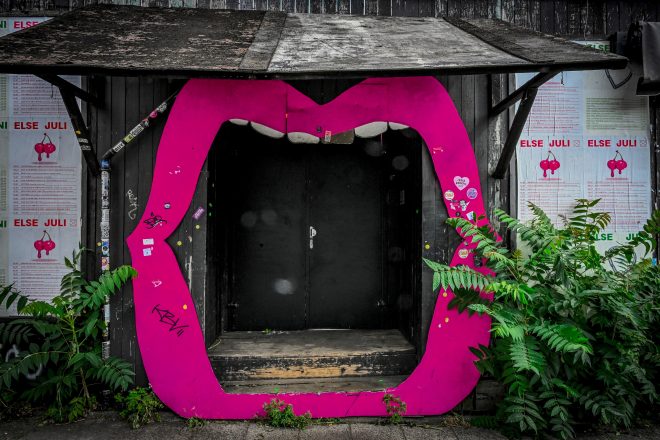
For 13 years, ELSE has offered a version of Berlin clubbing that refuses the usual darkness. Built from shipping containers on an abandoned patch beside the Spree, the seasonal venue has survived redevelopment pressure, shifting audiences and the brutal economics of nightlife without losing its sense of freedom. As it prepares for a 40-hour birthday session, ELSE is looking beyond survival and towards its next chapter.
Berlin nightlife is usually described through darkness.
Concrete corridors. Smoke hanging above a dancefloor. Steel, sweat and the deliberate removal of anything resembling daylight. It is an image repeated so often that it has become an international shorthand for the city itself.
ELSE does not fit neatly into it.
The club sits between Treptower Park, the Elsenbrücke and the railway line, with trains shaking the edges of the site and the Spree moving quietly alongside it. Trees surround the dancefloor. People arrive in sunglasses. The party begins under open sky, drifts indoors after dark and returns to the garden when morning comes back.
It feels less like an escape from Berlin than a compressed version of it. Infrastructure, nature, noise, water, movement and people occupying whatever space the city has failed to define.
ELSE was never designed as a permanent monument. It began as an experiment.
“When ELSE started, there wasn’t a specific long-term goal or plan,” the team says. “In Berlin fashion, we opened the venue with the best of intentions and a dream to see what we could do with what we had.”
That lack of certainty was not unusual. Berlin club culture has always been shaped by temporary leases, improvised architecture and the knowledge that any room, building or patch of land can disappear.
“We always hope for a long and successful future, but the goal is just to do what we love and hope to do it for as long as we can.”
Thirteen years later, the temporary experiment has become an institution.
BUILDING ON WASTELAND
The site that became ELSE was discovered in 2013 between a railway embankment and the Elsenbrücke. It was classified as a brownfield site, land generally associated with previous use, contamination, abandonment or infrastructure so limited that redevelopment becomes immediately complicated.
There was no water. No electricity. No utilities. No permission to construct permanent buildings.
To most developers, it looked unusable.
To a Berlin promoter, it looked possible.
The original search was connected to Renate, ELSE’s sister venue. Renate had no space for outdoor programming, and the team wanted somewhere nearby that could accommodate open-air events.
“The idea was indeed to find a location for open-air events, something that had always been difficult in Berlin,” the team explains. “Our sister venue Renate didn’t have space for open airs, so we were searching for something to help us grow that location.”
The proximity was useful, but the site quickly demanded an identity of its own.
“What started as an idea to grow one venue turned into a venue with its own unique identity.”
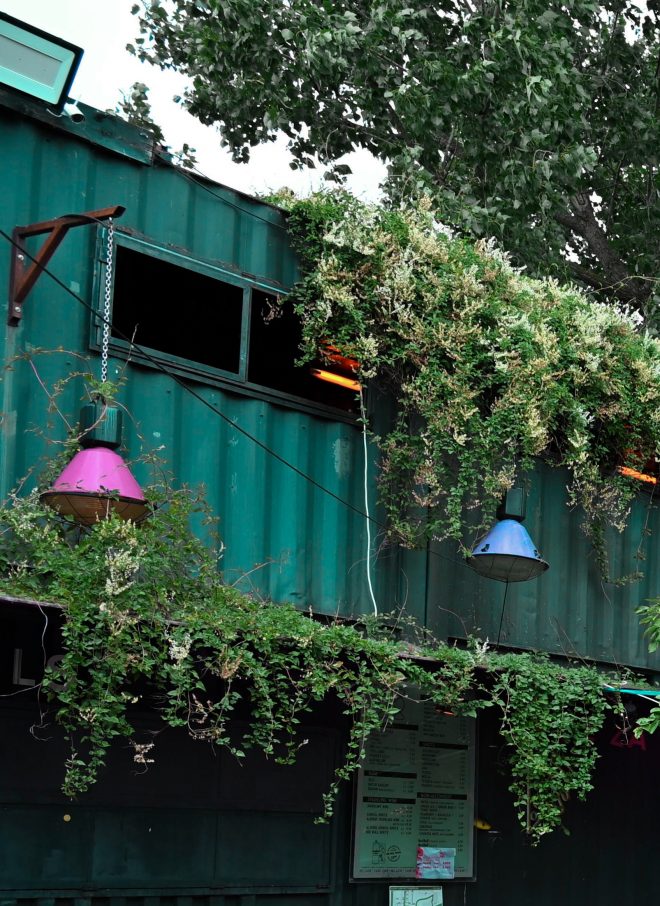
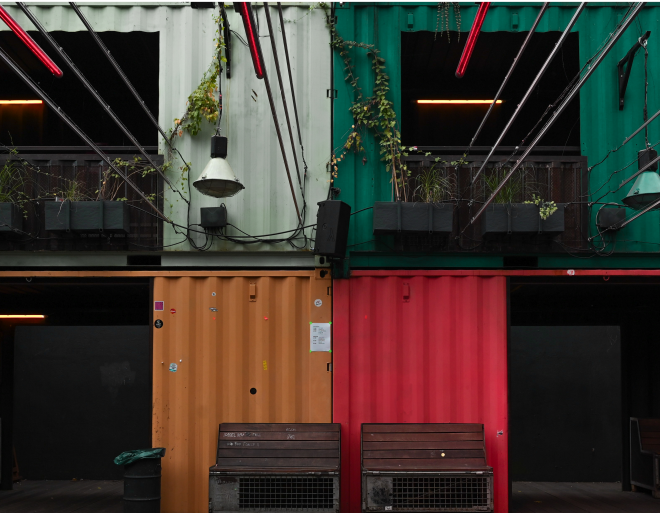
The restrictions shaped the architecture. Without permission to build a conventional structure, the team turned to freight containers. They became bars, walls, rooms and barriers designed to contain sound and protect nearby residents.
“The nature of the space itself is what led the construction of the club,” the team says. “There was absolutely no infrastructure to utilise, nor permission to build something permanent. This is why the choice was made to use shipping containers, allowing us to create defined spaces for the club and a sound barrier to protect neighbours from noise disturbance.”
What began as a practical solution gradually became part of ELSE’s character.
The early version was rough. Containers, trailers and a near-punk approach to construction gave it the feeling of something assembled quickly because people wanted to dance and were not prepared to wait for perfect conditions.
Over time, it became more refined. The spaces improved. Production became sharper. The indoor floor was renovated and fitted with a Kirsch Audio system. What had once felt like raw improvisation evolved into a carefully engineered venue without losing the evidence of how it had been built.
It still does not look impossible enough to be false.
A CLUB SHAPED BY ITS SURROUNDINGS
The location did more than determine the materials. It defined the experience.
From the beginning, the team knew that the Spree, the trees and the bridge could not be treated as background scenery.
“With such picturesque scenery around the site, we knew from day one that we wanted to make this a leading feature of our plans,” the team says.
The outdoor floor was built with an amphitheatre-like shape, creating a wide curve around the booth rather than forcing the crowd into one narrow point of attention. Sun decks, shaded corners, a cocktail bar beside the water and small spaces between the trees allow the venue to breathe.
The dancefloor is large, but it rarely feels anonymous.
Sound and energy move across the entire space. The crowd can see itself. The artist is not separated from the room by darkness, distance or an oversized stage structure. At peak moments, the reaction spreads visibly from the front to the outer edges.
Artists regularly tell the team that this relationship between booth and audience feels different from a standard open-air festival.
The setting gives ELSE its softness, but the infrastructure around it keeps the city present. Trains pass. The bridge hangs overhead. The sound of Berlin does not disappear when the music begins.
“Both the challenges and perks of the location are what made us the club we are and what we look towards to keep it special.”
SIX MONTHS ON, SIX MONTHS GONE
ELSE opens from April until September.
The seasonal structure is central to its appeal. The venue arrives with the end of the Berlin winter and disappears as the city begins turning grey again. Its calendar follows the weather rather than fighting it.
“Berlin summer is a fleeting moment between harsh winters,” the team says. “In the summer, we want to enjoy the sunshine and dance in the open air. In winter, we want a reprieve from the cold inside a warm, sweaty club.”
Rather than forcing the site into year-round operation, ELSE accepts what it is.
“Open-air clubs are at their most fun and comfortable in the summer, so rather than trying to force a location to be an all-year club, we choose to operate when we can provide the best experience that our city wants.”
That choice comes with serious operational pressure.
The club effectively closes and reopens every year. Structures need to be repaired. Surfaces need to be refreshed. Teams need to be rebuilt. Programming has to be locked. Bars, security systems, production, sound and site logistics must all be prepared inside a short window.
Once the season starts, there is little room to slow down.
“You have a short window to get ready, then once the season starts it’s nonstop,” the team says. “No adjustments, no pivoting, just focusing on making a great experience week after week.”
A core group returns each year, supported by construction crews and new seasonal staff. That combination of continuity and new energy stops the operation from becoming completely habitual.
Zoe Uellendahl, Manager at ELSE, sees the seasonal reset as both pressure and permission.
“The efforts of refining the space, making renovations, building a team and programme have the increased pressure of a limited time to operate and build the structures needed to support the tight turnaround of being such a high-volume, well-respected club with limited months open,” she says.
But reopening also creates a recurring opportunity to question everything.
“We all get to ask ourselves: What will happen next? What will be new? What will we keep? How can we improve and be the best experience possible?”
A year-round venue can easily become trapped in its own systems. ELSE is forced to look again.
“We don’t get stuck in trends or patterns when we have the challenge and opportunity of almost starting from scratch year after year.”
The closing is part of the mythology. Guests know that the final weekend matters because the garden will soon vanish. The reopening matters because it confirms that summer has returned.
THIRTEEN YEARS OF CHANGE
Longevity is no longer normal in Berlin nightlife.
Clubs operate under pressure from rising costs, changing tourism, real estate development and infrastructure projects that treat cultural venues as temporary obstacles. The construction of the A100 motorway has become one of the most visible threats to spaces across the city.
ELSE has survived, but survival has never meant standing still.
“The special thing about Berlin’s club scene is that it has always experienced change on a large scale but has always adapted,” the team says. “There is always a new challenge, a new trend, closures and openings.”
The city does not party in the same way it did in 2013. Audiences are different. Musical cycles move faster. Expectations around safety, representation, sound and programming have evolved. A new generation is entering both the dancefloor and the institutions responsible for maintaining it.
“Over the years, we have seen the way the city parties, the music they love and the things people want to experience change, but listening and adapting to this is what keeps things going.”
ELSE does not see itself as an observer standing outside those changes.
“With 13 years in operation, we are also part of this change,” the team says. “We have a new generation stepping in, both in our team and the community at large.”
The responsibility is not simply to react to whatever becomes popular. It is to contribute.
“It’s important to be part of the change, not just respond to it.”
That distinction shapes how ELSE approaches local culture, international programming and the next generation of promoters.
NO INTEREST IN HEADLINER WORSHIP
ELSE’s booking team for the 2026 season, Timm Mühlenberg and Jan Hollstein, joined with a brief built around balance.
International artists matter. So do local selectors. Established names can bring scale, but emerging artists and underground collectives are often the ones creating the next version of the city’s culture.
The club’s lineups attempt to hold those worlds together.
Mühlenberg, a born and raised Berliner, is conscious of the weight attached to booking a venue with an international audience.
“Berlin possesses an incredibly strong and distinctive club culture, and as a result, international trends often take longer to catch on here than elsewhere,” he says. “But that is precisely what makes the city so special.”
Protecting local taste does not mean building a wall around it.
“While we must remain true to the city’s own local tastes, our responsibility doesn’t end at the city limits,” Mühlenberg says. “We also want to introduce external influences and connect international artists, brands and new musical styles with the local scene.”
That approach extends to partnerships with promoters and collectives.
PULS and its BERLIN COMMON GROUND concept are central to that work. The series moves away from headliner culture and invites smaller collectives to curate events using ELSE’s platform and infrastructure.
The principle is simple. A venue that has accumulated visibility over 13 years has a responsibility to share it.
Booking established artists is not difficult when budgets and dates align. Supporting less visible communities requires more trust, more patience and a willingness to measure value beyond immediate ticket sales.
ELSE wants both.
FORTY HOURS, NO CLEAN ENDING
The club’s 13th birthday will run for 40 hours, from Saturday, August 8 until Monday, August 10.
The lineup moves across generations and scenes. Angel D’lite, COZi, Dee Diggs b2b Stella Zekri, DJ TOOL, Nightmares on Wax, Thabo and Young Marco take over Saturday. Sunday brings ALI3N, Blue Hour, Cecilia Tosh, Kameliia, Len Faki, Matrixxman, nthng, Stephanie Sykes and Vincent Neumann.
The Night Garden will be curated with AOS, Coconut Concepts and PULS, keeping the outdoor floor moving through the hours when most open-air programming would normally disappear.
The booking team wanted the weekend to reflect the relationships that built ELSE, while creating room for new names.
“Our booking team had the vision of making sure we include the artists and collectives that help us define our sound and community, alongside some new names that we think our guests will love and the names that they want to see.”
The birthday is not designed around a single peak set.
It is meant to reproduce the full ELSE cycle.
“For us, it’s not just about headliners,” the team says. “It’s about showcasing the ELSE experience: a day of fun in the sun, dancing in the open air, sharing a cocktail to beat the heat, scurrying indoors when the night comes and then back into the garden when the sun comes back.”
Long sessions allow guests to enter and leave without feeling that they have missed the only moment that matters.
“You can pop in for a few hours, or you can come and go all weekend,” the team says. “There will always be a friendly face, some great music and a good time waiting for you.”
ELSE often feels like a small festival operating every weekend. The birthday simply stretches that identity to its natural limit.
THE MOMENTS THAT STAY
A club’s history is rarely remembered through spreadsheets, ticket counts or annual reports.
It survives through moments.
A track landing at exactly the right time. A crowd cheering when a set ends. People meeting on a dancefloor and returning together the following year. An artist looking out at the room and realising that the connection is real.
“The personal moments we witness are always the most special,” the team says. “Seeing thousands of people dancing and feeling free, the gasps and cheers when a track makes them feel something, the applause when someone finishes a great set, seeing people make new friends, find new parties and DJs. It’s the contribution to the culture that sticks.”
Some memories stand above others.
Hosting Floorplan for the 2026 opening carried the weight of bringing foundational music into a space built because of it.
“Hosting Floorplan for our opening this season was a real pinch-me moment, where we got to host someone who literally helped to create the music we owe this all to.”
Freddy K’s Key Vinyl party has become a ritual in its own right. Hundreds of people return for it every year, allowing the event to develop a history inside the history of the venue.
HEISSS has built a similar relationship with the space. Earlier this season, the promoter hosted its own 40-hour session, bringing together house and techno artists alongside smaller Berlin collectives handling stage takeovers.
The venue remained full through Monday.
“Seeing thousands of people dancing all day on a Monday until the early hours of Tuesday was the cherry on top,” the team says. “Berlin will always be a special place for music and nightlife, and events like this show it.”
These are the scenes that justify the work required to rebuild the club every year.
“Knowing that by working hard, we can give back to the scene and help people feel something.”
RESIDENTS, TOURING AND THE NEXT CHAPTER
ELSE is now considering how its identity can exist beyond the summer season.
The team is exploring a residency programme, but refuses to treat residents as another set of names used to fill recurring dates.
Hollstein sees a residency as a long-term creative relationship.
“We aren’t interested in interchangeable names or fleeting trends,” he says. “We seek artists whose music clearly reflects a unique perspective, a story and a distinct artistic world that can be developed together during the residency.”
Residents could return for special B2B sets, curate their own nights or invite artists who have influenced their music.
“For us, a residency is more than just a regular appearance in the programme,” Hollstein says. “It is an opportunity to co-author a long-term, unmistakable chapter in the story of ELSE and allow our guests to experience different facets of an artist over time.”
The club is also looking at international touring during the Berlin off-season.
The goal is not to copy the venue in another city. ELSE without the Spree, the bridge and the garden would only be an imitation.
Instead, the team wants to extend its relationships by working with venues and collectives that already possess a strong local identity.
“We have previously partnered with clubs and collectives that possess a strong identity of their own and share our values, with the aim of developing formats where our curatorial signature meets the local scene,” Hollstein says.
Touring would allow Berlin-based artists and future residents to connect with new communities while maintaining ELSE’s presence during the months when the physical venue is closed.
“There are only so many days of summer in Berlin,” he says. “Visiting other cities keeps those relationships solid and ongoing by bringing ELSE residents and Berlin-based artists together with the voices of the host city.”
It is expansion without replication.
STILL TEMPORARY, STILL HERE
ELSE began with no infrastructure, no permanent building and no guarantee that it would survive its first years.
That instability never completely disappeared.
The city continues to change around it. Development pressure remains. Operating costs continue to rise. Clubs close. New ones open. Audiences shift. The next challenge is always waiting.
But ELSE is still there.
A seasonal club built from containers has become one of Berlin’s most recognisable summer spaces. Not by competing with the darkness associated with the city, but by offering something Berlin needed just as much.
Sunlight. Water. Trees. Space to breathe.
“Making what was seen as a temporary space into a permanent institution is something we are very proud of,” the team says. “As we look to the future, we hope to keep this good thing going for as long as we can.”
Thirteen years is not proof that ELSE has escaped the uncertainty of Berlin nightlife.
It is proof that uncertainty can still produce something lasting.
